Why you should track net worth, not just spending
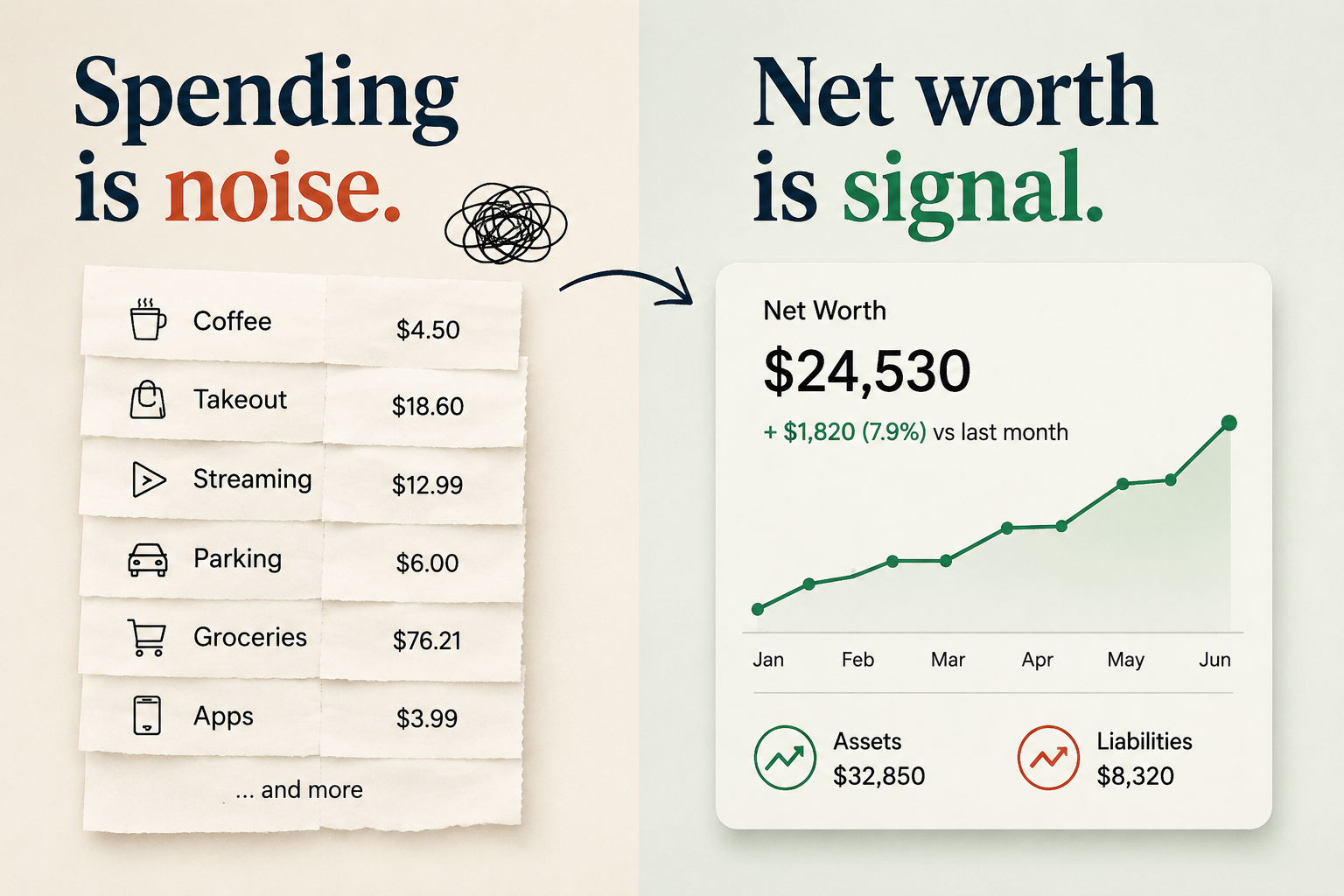
Most people who decide to get serious about money start by tracking every expense. Every coffee, every takeaway, every streaming subscription gets logged and judged. It feels productive. But spending alone is a terrible proxy for financial health — and obsessing over it can make you feel worse without making you actually better off.
The number worth watching is net worth.
What net worth actually is
Net worth is simple arithmetic: everything you own minus everything you owe.
Assets (what you own) might include your bank accounts, savings, retirement or pension accounts, investments, and the market value of any property. Liabilities (what you owe) include credit card balances, personal loans, car loans, a mortgage, or student debt.
Subtract the second list from the first. The result is your net worth. It might be positive. It might be negative, especially early in life — that's normal and not catastrophic. What matters is the direction it's moving.
Why spending-focused tracking lies to you
Here's the problem with watching spending: you can have a "good" spending month and still fall behind.
Imagine you stuck to your budget perfectly in March. But your credit card carried a balance that accrued interest, your retirement contributions weren't enough to grow your total, and you didn't put anything into savings. Every expense was within the plan — and you still ended the month with less total wealth than you started.
Spending tells you what left your wallet. Net worth tells you whether you're winning.
The reverse is also true. A month where you spent more than usual on a car service, a dentist, and a new work laptop might look alarming on a spending breakdown. But if you paid cash and didn't take on any debt, your net worth might have barely moved. You traded money for things you needed.
The one question to ask every month
Instead of: "Did I overspend on dining out?"
Ask: "Am I worth more this month than last month?"
If yes, you're moving in the right direction — whatever your spending looked like. If no, it's worth understanding why. Did a debt balance go up? Did an asset drop in value? Did you dip into savings for something unexpected? That's useful signal. It's not about blame; it's about understanding.
For example, if you had $3,200 in savings and investments last month and owed $800, your net worth was $2,400. This month you have $3,450 and owe $750 — net worth is $2,700. That $300 improvement matters more than whether one spending category looked messy.
TIP
PlainFinance is built around this monthly check-in. Add your accounts, loans, investments, and balances once a month, and your dashboard shows whether your net worth is moving in the right direction — without turning your finances into a daily chore.
What to include (and what to leave out)
Include:
- Every bank account you actually use
- Retirement or pension account balances (they count, even if you can't touch them yet)
- Investment accounts — shares/stocks, funds, ETFs
- Property, at a conservative estimate (not what you hope it's worth — what you'd realistically sell it for)
- Any money owed to you that's genuinely likely to come back
Liabilities to include:
- Credit card balances (the balance you carry, not the limit)
- Personal loans
- Car loans
- Mortgage outstanding balance
- Student debt
Leave out:
- Things you can't easily value and wouldn't sell — furniture, clothes, your vehicle if it's only used for transport
- Pending income that isn't in your account yet
The point isn't precision. It's a consistent, comparable number you update on the same basis each month. A rough net worth tracked consistently beats a precise one calculated once.
How often to check
Monthly. Not daily, not weekly.
Checking daily turns into noise — markets move, account balances fluctuate, and you'll end up anxious about things you can't control. Checking monthly gives you enough distance to see a signal.
Pick one day — the first of the month, or the same date every month — update your numbers, note the change, and move on. The whole exercise should take five minutes.
Why net worth is the cleaner signal
A rising net worth means your financial life is improving, even in months where it didn't feel like it. A flat or falling net worth tells you something is worth looking at, even in months where your spending felt under control.
It's a cleaner signal than any spending category. You can argue about whether a restaurant meal was "dining out" or "a work dinner." You can't argue with the number that tells you whether you ended the month ahead or behind.
Track it once a month. Everything else is commentary.
Keep reading
All articles →Best YNAB Alternatives in 2026 (Free Options That Don't Require Bank Access)
YNAB's price hikes and mandatory bank connections have pushed a lot of people to look elsewhere. Here's an honest look at the best alternatives — including free options that work without linking your accounts.

How to import HDFC, ICICI, and SBI bank statements into PlainFinance (no bank login needed)
Export HDFC, ICICI, and SBI bank statements and import them into PlainFinance — a personal finance app without bank linking. No aggregators, no logins.