Best YNAB Alternatives in 2026 (Free Options That Don't Require Bank Access)
YNAB used to be the gold standard for personal budgeting software. For a lot of people, it still is. But something changed when YNAB hiked its price to $14.99 a month — or $109 a year — and made syncing your bank account the assumed path forward.
The result: a steady stream of people Googling "YNAB alternative" and wondering if they're missing something obvious.
Some are leaving over the price. Some are uncomfortable handing over bank credentials to a third-party sync service like Plaid. Some just don't want to be told how to budget — zero-based budgeting works brilliantly for some people and feels like a part-time job for others. And some simply live in a country where YNAB's bank connections don't work well, or at all.
Whatever your reason, there are genuinely good alternatives. Here's an honest look at them.
The real decision is not just "YNAB vs cheaper app." It is automatic bank sync vs file-based control. Bank-sync apps save time, but require ongoing account access through aggregators like Plaid. CSV/PDF-first tools ask for a small manual step, but give you more control over what financial data leaves your bank. Knowing which side of that trade-off suits you will make this list much easier to read.
Quick picks by use case
| Need | Best option |
|---|---|
| No bank login required | PlainFinance (first 50 users get lifetime free) |
| Free YNAB-style zero-based budgeting | Actual Budget |
| Best polished automated experience | Copilot |
| Long-term cash flow forecasting | PocketSmith |
| Power-user reporting and API access | Lunch Money |
| Completely free and fully manual | Spreadsheets |
What to Actually Look for in a YNAB Alternative
Before diving into the list, it helps to know what problem you're actually trying to solve. Ask yourself:
- Price — Are you looking for free, or just something cheaper than $109/year?
- Bank connection — Do you want automatic transaction import, or are you fine uploading CSV/PDF files from your bank?
- Methodology — Do you want zero-based budgeting baked in, or a more flexible approach?
- Privacy — How comfortable are you with a third party holding read access to your bank accounts?
- Platform — Web only? iOS? Android? All three?
The answer to "which YNAB alternative is best" is genuinely different depending on your answers. So this list covers the full range — not just what's cheapest or most popular.
The Best YNAB Alternatives in 2026
1. PlainFinance — Best for Privacy-Conscious Users Who Don't Want Bank Login
Price: Free tier available; paid plan for more features Bank login required: No Platform: Web
PlainFinance takes a fundamentally different approach: instead of connecting to your bank through a third-party service, you upload your bank statements directly — CSV exports or PDF statements, whichever your bank provides.
No Plaid. No Open Banking. No credentials stored anywhere. Your transactions are imported from files you control, not pulled from a live bank connection.
This matters for two reasons. First, it works globally — any bank, any country, any statement format. If your bank is a regional credit union in Manitoba or a neobank in Australia, it doesn't matter. If you can download a statement, you can use PlainFinance. Second, there's no third party sitting between you and your financial data.
Once your transactions are in, you get categorisation, budget tracking, net worth tracking, goals, and subscriptions monitoring. The budgeting is flexible — you're not forced into a zero-based framework if that's not how you think.
The first 50 users get lifetime free access — no subscription, no expiry. After that, there's a free tier that covers the basics most people need to test the workflow, and a paid plan for people who want more history, more accounts, and deeper tracking over time.
Honest caveat: If you want fully automatic daily sync with no manual steps, this isn't the tool for you. Uploading statements is a once-a-month task, but it is a manual step. Some people find this refreshing — it forces a brief moment of intentionality with their finances. Others find it annoying. Know which camp you're in.
Best for: People who care about privacy, live outside the US/UK bank-sync sweet spot, or simply don't want to grant third-party read access to their accounts.
2. Actual Budget — Best Free YNAB Alternative (Open Source)
Price: Free if self-hosted; low-cost hosting via PikaPods, typically around $1.50–$1.80/month depending on setup; optional bank-sync costs may apply Bank login required: Optional (can use manual import) Platform: Web, Desktop, mobile web/PWA
Actual Budget is the closest thing to YNAB's philosophy at zero cost. It's open source, uses zero-based budgeting, and has a clean interface that YNAB users will recognise immediately. You can self-host it entirely for free, or pay a small fee for managed hosting through a service like PikaPods.
Bank sync is available through third-party providers, but availability varies by region and provider status — so manual import is the safest assumption if that matters to you. Actual runs perfectly well without any bank connection.
Honest caveat: Self-hosting requires some comfort with running a server or Docker container. The hosted option removes that friction, but now you're paying again — though still much less than YNAB. The app also doesn't have the polish or support infrastructure of a commercial product.
Best for: YNAB refugees who specifically want zero-based budgeting and are comfortable with open-source software.
3. Lunch Money — Best for Developers and Power Users
Price: $10/month or $100/year Bank login required: Optional Platform: Web-first, with iOS and Android companion apps
Lunch Money is a well-regarded personal finance tool built by a solo developer. It supports bank sync via Plaid (US) and CSV imports for everyone else. The interface is information-dense in a good way — it's the kind of tool that programmers tend to love.
It's not zero-based. You can set up budgets, track net worth, and run detailed reports. There's also an API, which is either irrelevant to you or the entire reason you'd choose it over everything else on this list.
The annual plan is straightforward at $100/year, and all core features are included.
Honest caveat: The mobile apps are companion apps rather than the main experience, so Lunch Money still feels web-first compared with mobile-native tools like Copilot. And if you're not a CSV-comfortable person, the non-US manual import experience can be clunky.
Best for: Tech-comfortable users who want a flexible, non-zero-based tool with power features and good reporting.
4. Copilot — Best Polished Bank-Sync Alternative for Apple-First US Users
Price: $13/month or $95/year Bank login required: Yes (primarily; manual accounts supported) Platform: iPhone, iPad, Mac, Web
Copilot is one of the most beautifully designed personal finance apps available. If you're in the US and primarily on Apple devices, it's worth a serious look. Bank sync works well, categorisation is intelligent, and the overall experience is more pleasant than YNAB. Manual accounts and manual transactions are supported, though the app is designed around connected accounts as the primary workflow.
Honest caveat: Bank connection is the assumed path — if you want to stay fully manual, Copilot isn't built for that. And at $95/year, it's not significantly cheaper than YNAB. If you're outside the US, bank sync coverage drops sharply.
Best for: Apple-ecosystem users in the US who want a polished, automated experience and don't mind connecting their accounts.
5. PocketSmith — Best for Long-Term Financial Planning
Price: Free tier; paid from $9.99/month billed annually or $14.95 month-to-month Bank login required: Optional; both automatic bank feeds and manual import are available on free and paid plans Platform: Web, iOS, Android
PocketSmith is a New Zealand-based tool that's been around for years and has unusually strong international bank coverage — over 12,000 institutions across 49 countries. Its standout feature is calendar-based forecasting — you can project your finances months or years into the future based on recurring transactions and expected income.
The free tier covers up to two accounts with both manual import and automatic bank feeds available. Paid plans extend account limits, projection horizon, and additional features.
Honest caveat: The interface is functional rather than beautiful. And the forecasting features, while genuinely powerful, have a learning curve. If you want a simple month-to-month budget tracker, PocketSmith is more than you need.
Best for: People who want serious long-term cash flow forecasting, especially those outside the US where bank coverage from US-centric tools is patchy.
6. Spreadsheets — The Free YNAB Alternative That Always Works
Price: Free Bank login required: No Platform: Everywhere
This is on the list because it's the honest answer for a lot of people. Google Sheets or Excel with a downloaded template can handle budgeting, net worth tracking, and category summaries with zero cost and zero privacy concerns. There are solid free YNAB-style templates available, and the customisability is absolute.
Honest caveat: Spreadsheets don't scale gracefully. Manually entering 200 transactions is tedious. There's no automation, no categorisation intelligence, and no mobile-friendly interface. If you've tried spreadsheets and abandoned them, you know why.
Best for: People with simple finances, high tolerance for manual work, or a strong distrust of all software-as-a-service tools.
Quick Comparison Table
| Tool | Price | Bank Login Required | Platform | Best For |
|---|---|---|---|---|
| PlainFinance | Free tier; paid plan available | No — CSV/PDF upload | Web | Privacy, global users, no bank-link |
| Actual Budget | Free self-hosted; low-cost hosted option | Optional | Web, Desktop, mobile web | YNAB-style ZBB, open source |
| Lunch Money | $10/mo or $100/yr | Optional | Web-first + mobile apps | Power users, developers |
| Copilot | $13/mo or $95/yr | Yes (manual accounts supported) | iPhone, iPad, Mac, Web | US Apple-ecosystem users, polished UX |
| PocketSmith | Free tier; from $9.99/mo (annual) | Optional | Web, Mobile | Long-term forecasting, international |
| Spreadsheets | Free | No | Everywhere | Simple finances, full control |
Which One Is Right for You?
You hate the idea of giving an app your bank login → PlainFinance or Actual Budget (manual mode). Both let you import transactions from files without ever connecting an account.
You want something free and philosophically similar to YNAB → Actual Budget. It's the most direct free alternative for people who liked the zero-based methodology but not the price.
You want the most automated experience possible → Copilot if you're in the US and mainly use Apple devices, PocketSmith if you're international or need a web app.
You're a developer or power user who wants data access → Lunch Money, particularly if the API, reporting depth, or web-first workflow appeals to you.
You just need something simple → Spreadsheets. Genuinely. Don't let anyone make you feel like you need a subscription to manage your money.
You may also see Monarch Money, Simplifi by Quicken, EveryDollar, PocketGuard, and Goodbudget mentioned in YNAB-alternative lists. They can be useful, particularly for US users who want bank sync and don't mind a subscription. This guide focuses on tools that either offer strong manual import options, meaningful international coverage, or a distinctly different budgeting workflow — which is why those apps aren't covered in depth here.
The right YNAB alternative depends almost entirely on whether you want automation or control. YNAB optimised for automation and built its methodology around it. The tools above cover the full range from fully automated to fully manual.
If privacy is your primary concern — or if you've simply had it with granting apps access to your bank — the CSV-import route (PlainFinance, Actual Budget in manual mode, or a spreadsheet) gives you full visibility into your finances without handing read access to a third party. That trade-off — one upload every few weeks instead of daily automatic sync — is a small price for a lot of people.
For others, the automation is the whole point, and a bank-connected tool makes sense. Just go in knowing that's the trade you're making.
Keep reading
All articles →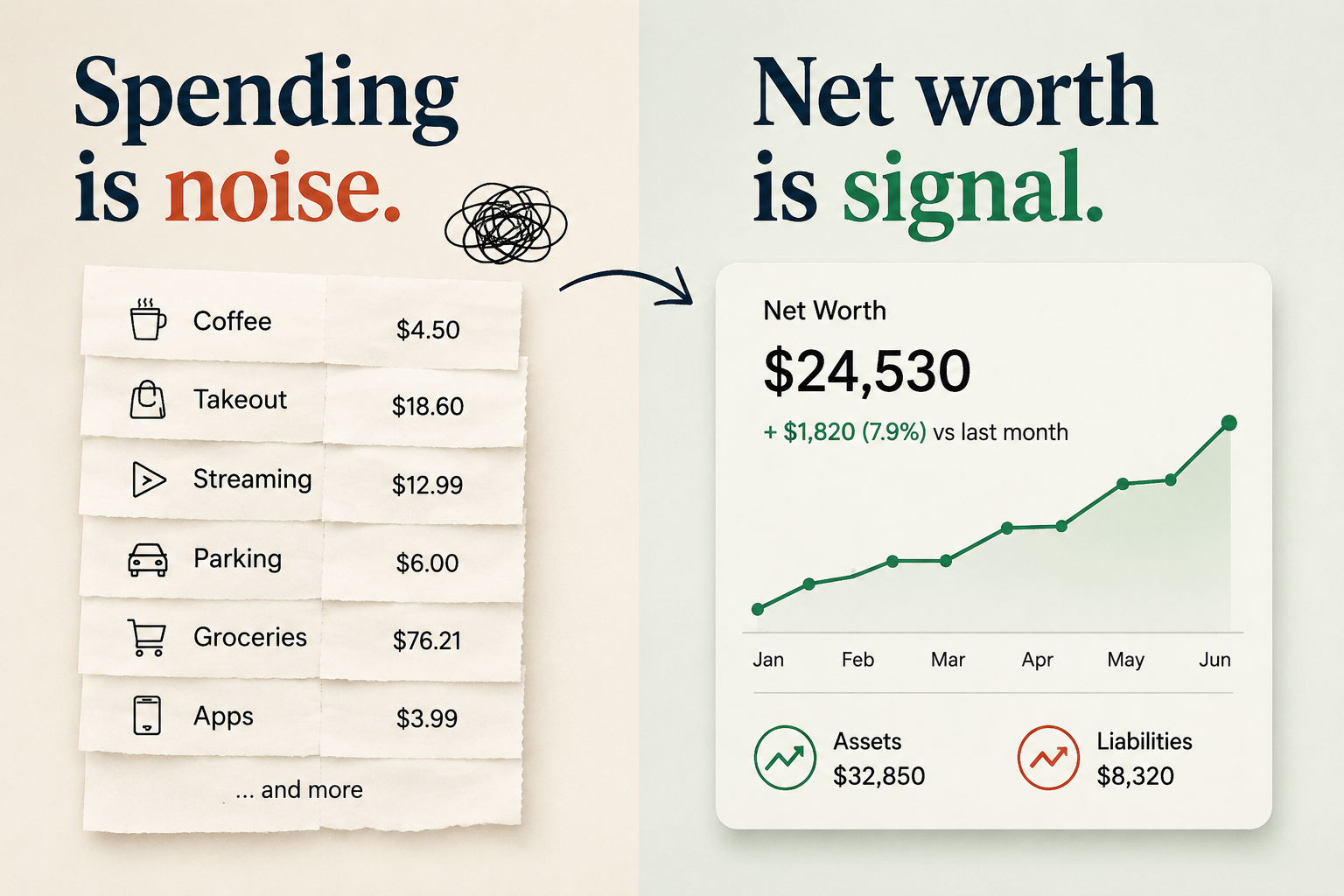
Why you should track net worth, not just spending
Watching every small expense is exhausting and often misses the point. Net worth is the number that tells you whether your money is actually moving in the right direction.
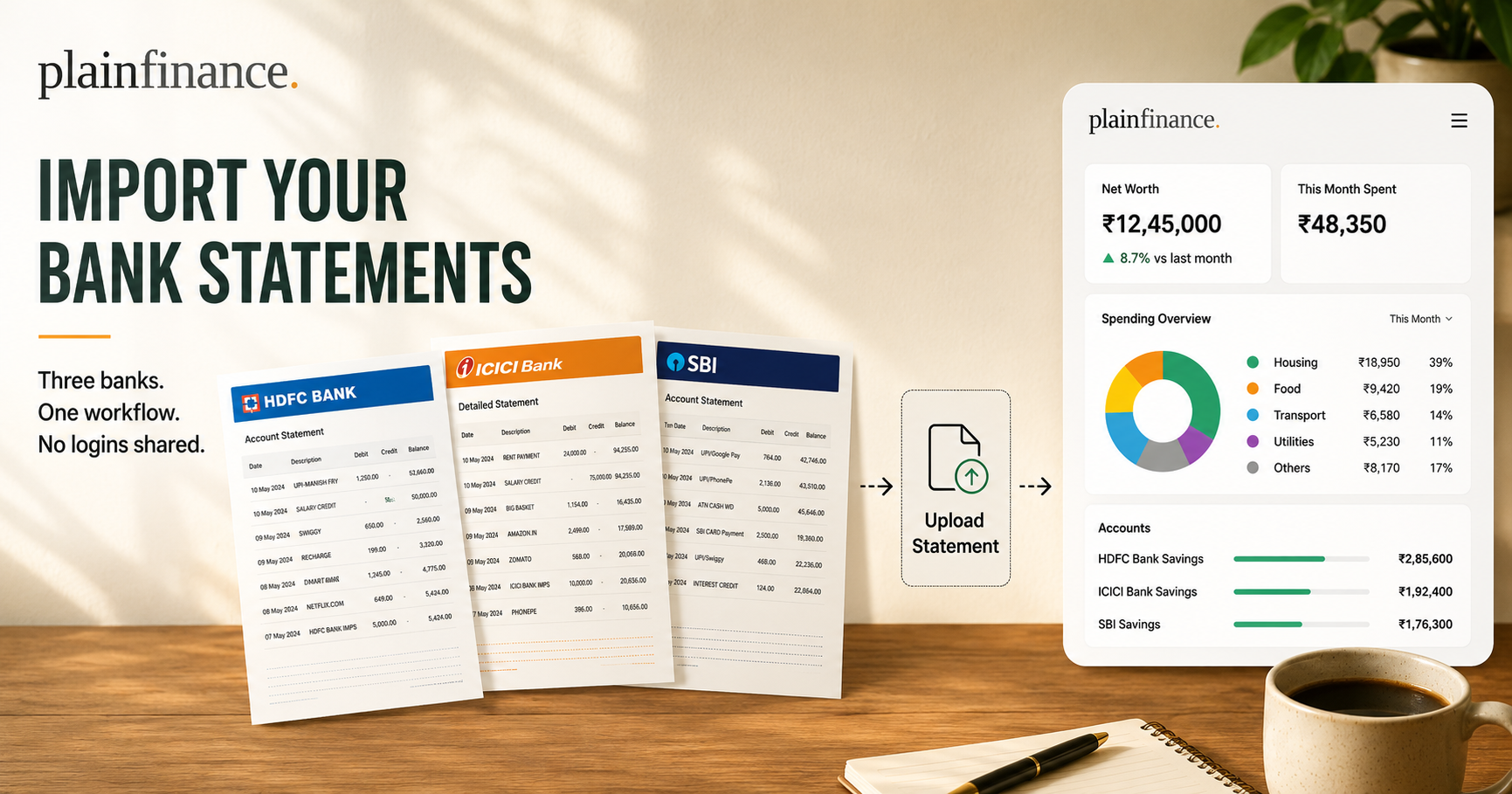
How to import HDFC, ICICI, and SBI bank statements into PlainFinance (no bank login needed)
Export HDFC, ICICI, and SBI bank statements and import them into PlainFinance — a personal finance app without bank linking. No aggregators, no logins.