Why we built PlainFinance: a personal finance app that never touches your bank
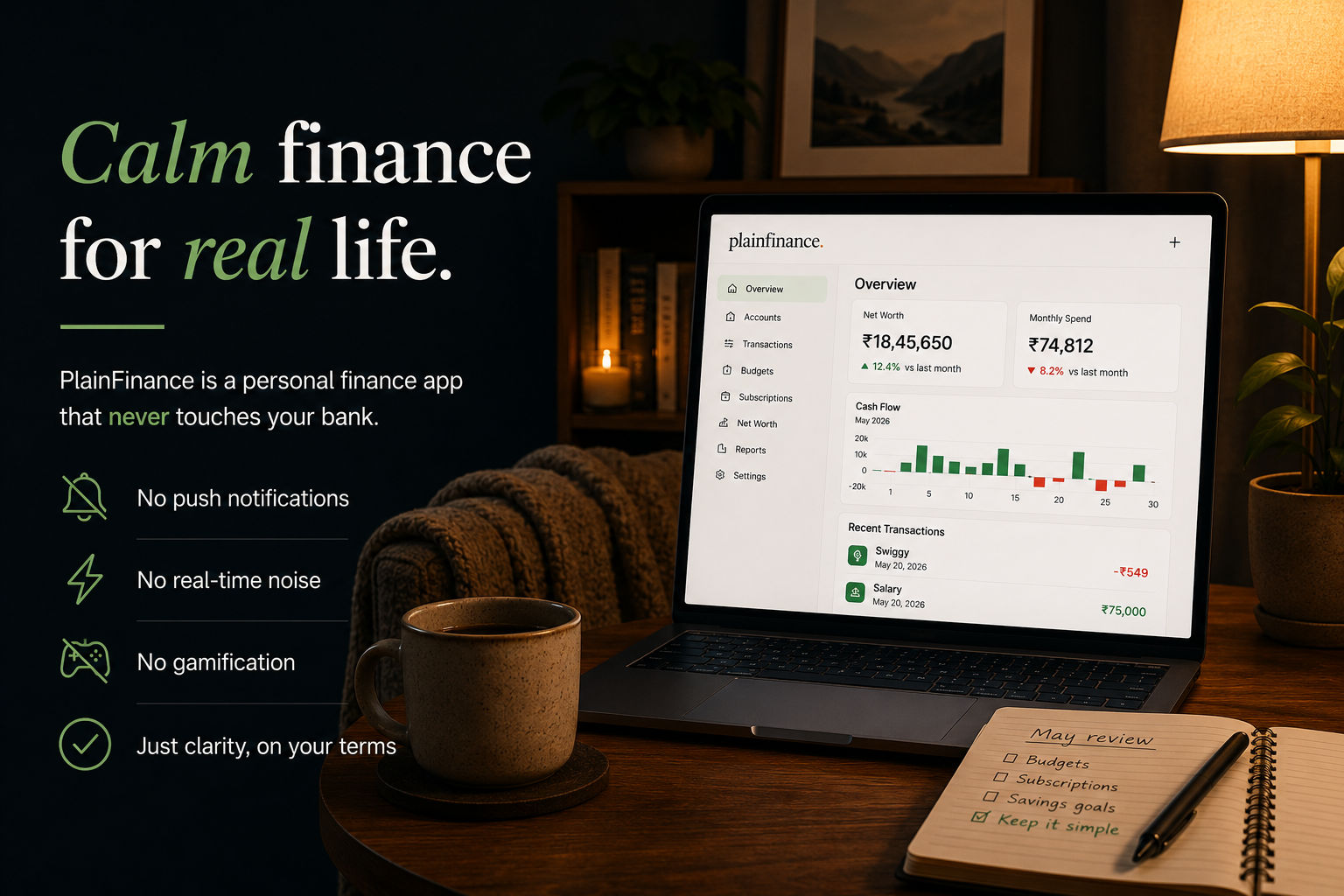
Every personal finance app you've tried starts the same way.
You sign up, you get a clean little dashboard, and then it asks you to do one thing: connect your bank account. There's usually a Plaid logo, or a list of bank logos, or a friendly "we use bank-level encryption" line. And there's a moment — maybe just half a second — where you pause and think, do I actually want to do this?
We built PlainFinance for the version of you that doesn't move past that pause.
What "connect your bank" actually means
When you click that button, you're not handing your data to the app you signed up for. You're handing it to an aggregator — Plaid, Yodlee, or one of a handful of similar services that sit between you and your bank. You're giving that aggregator your bank credentials (or, increasingly, an OAuth token that does roughly the same thing). And you're granting persistent, read-only access to every account it can see, indefinitely, on terms most people never read.
That's the deal underneath every "Connect with Plaid" button. It's not necessarily a bad deal — millions of people take it every day, and the aggregator companies are, by and large, careful. But it's a deal worth understanding before you say yes to it.
And it still breaks
Even if you're comfortable with the privacy trade, the practical experience tends to disappoint.
Mint — the app that taught a generation of people what budgeting software even looked like — shut down in 2023. Monarch, Copilot, Rocket Money, and the others that picked up the baton mostly run on the same aggregator pipes Mint used. The pipes break. Connections drop. Banks change their login pages and an entire app stops syncing for a week.
This is the real, unglamorous experience of modern money software: you spend more time reconnecting accounts than reading your numbers. The dashboard is fragile. The categorisation is over-automated and wrong half the time. The notifications optimise for engagement rather than clarity. The app you opened to feel calmer about your money becomes another thing buzzing for your attention.
And if you're not in the US or UK, none of it works anyway. Most aggregators don't cover Indian banks at all. If you bank with HDFC, Kotak, SBI, ICICI, Axis — or basically any bank outside a short list of supported regions — your options for a polished personal finance app are roughly zero.
Why CSVs are underrated
Here's the thing nobody talks about: your bank already gives you everything an aggregator would pull. It's called a CSV export.
Every bank, in every country, lets you download your statements as a CSV. It's free. It's the same transaction data Plaid would have read. You already own it — it lives in your downloads folder thirty seconds after you ask for it.
CSVs are boring in the best possible way.
They don't break when an API changes, because there is no API. They work in every country and at every bank, because the format predates the modern fintech stack by several decades. They're portable — you can open them in Excel, Numbers, a text editor, or a script you wrote in ten minutes. And thirty years from now, you'll still be able to open the ones you saved today. They are the most durable financial format that has ever existed.
Once a month, you download a file and upload it. That's the rhythm — and for most people, reviewing money once a month is enough to stay intentional without turning your finances into a live feed. In exchange, your bank credentials stay yours, the product doesn't need a permanent leash on your accounts to be useful, and the system still works the next time your bank redesigns its login page.
We built the whole product around that tradeoff.
A different feeling for finance software
Underneath the technical choice is a stance about what this kind of software should feel like.
Most modern money apps are loud. They push notifications, surface insights, suggest categories, gamify saving, prompt upgrades. They are optimised for engagement — which is to say, optimised to occupy your attention even when you have nothing to think about.
We wanted personal finance software to feel calm again.
Calm means you open it when you want to, not when it pings you. It shows you what's true about your money and then gets out of the way. It doesn't manufacture urgency. It doesn't pretend to know what you should do with your savings.
A CSV-first product enforces that posture on us as a company. You can't push behavioural nudges in real time when you only see the data once a month. You can't build engagement loops on top of a file the user uploaded on purpose. The architecture itself keeps the product honest.
What we built
PlainFinance is a personal finance app that runs on the CSVs you already have.
Upload a statement from any bank. We parse it, auto-categorise the transactions using rules you control, detect transfers between your own accounts so a credit-card payment doesn't show up as both an expense and a deposit, and give you the things you'd expect from a money app — budgets, subscriptions, net worth, a dashboard. Upload a second statement from the same bank next month and we recognise it instantly — same header, same mapping, no extra work for you. Upload a CSV from a bank we've never seen and you map the columns once; we remember it forever.
Some of this was harder than it sounds. Indian bank exports, for example, ship dates in at least six different formats — sometimes more than one inside the same file. Several put a preamble of metadata above the actual transactions. A few use a single "Dr/Cr" column instead of separate debit and credit columns. We handle each of these because, on the ground, that's what a CSV-first product actually has to do. The "boring" format gets interesting fast once you have to support real banks.
That's the whole product. No browser extension, no mobile app reading your SMS, no bank login screen.
What we deliberately didn't build
This part is the brand promise, so we'll keep it short and literal:
- No bank linking. No Plaid, no Yodlee, no aggregator integrations. Not on the roadmap.
- No API access to your accounts. We can't read your balance in real time, because we can't read your balance at all. Only what's in the CSVs you upload.
- No selling or "anonymised" use of your transaction data. Your data is yours.
- No ads. We sell a personal finance app. That's the business model.
If any of those change, this post changes with it.
Who this is for (and who it isn't)
PlainFinance is for people who want a complete picture of their money without granting bank access to a third party. It's for people in regions where bank-linking apps don't work at all. It's for anyone who's outgrown a spreadsheet and wants categories, budgets, and net worth without giving up control of the source data.
It is not for people who want a real-time push notification the second a charge hits. We can't do that, by design. If you need that — there are good apps for it, and you should use them.
A closing belief
If any of this resonated, sign up. No card, no bank linking, ever. The next post in this series will be a practical one: how to read a bank statement CSV — what each column actually means, why the same word can mean different things at different banks, and the small habits that make the monthly upload painless.
We'll leave you with the sentence the rest of the product is built on:
Your financial life shouldn't require permanent surveillance to be legible to you.
— The PlainFinance team
Keep reading
All articles →Best YNAB Alternatives in 2026 (Free Options That Don't Require Bank Access)
YNAB's price hikes and mandatory bank connections have pushed a lot of people to look elsewhere. Here's an honest look at the best alternatives — including free options that work without linking your accounts.
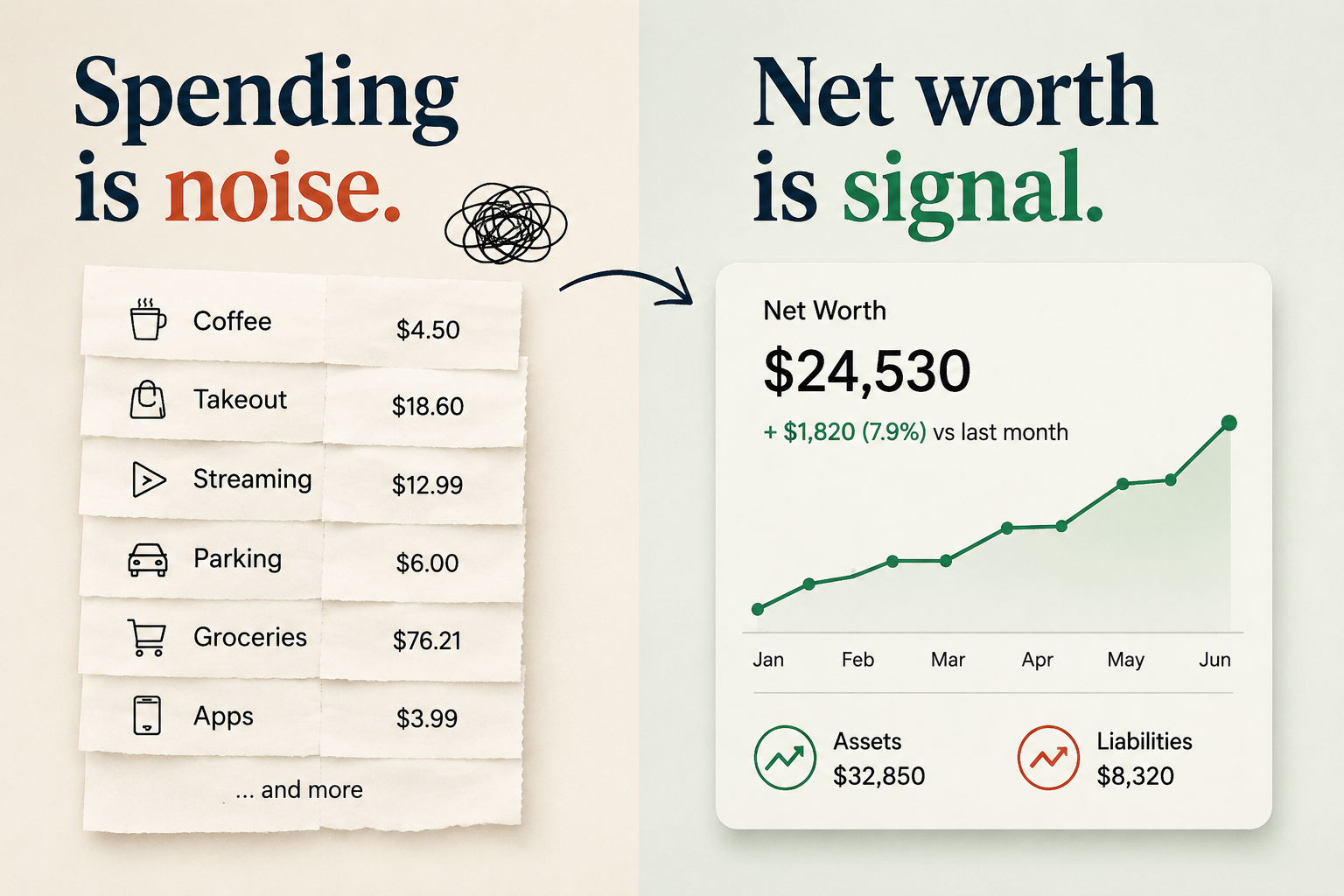
Why you should track net worth, not just spending
Watching every small expense is exhausting and often misses the point. Net worth is the number that tells you whether your money is actually moving in the right direction.
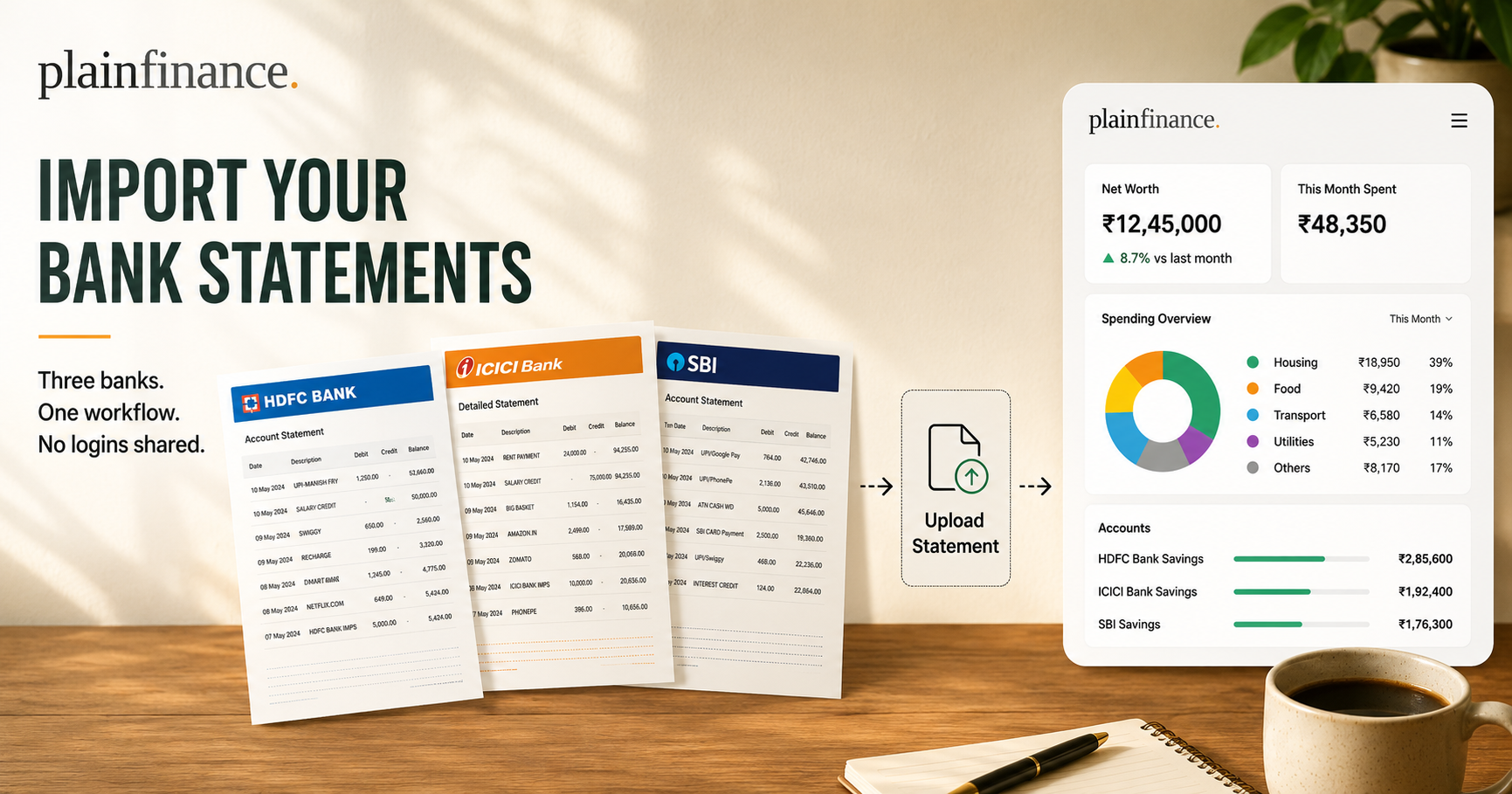
How to import HDFC, ICICI, and SBI bank statements into PlainFinance (no bank login needed)
Export HDFC, ICICI, and SBI bank statements and import them into PlainFinance — a personal finance app without bank linking. No aggregators, no logins.